
Weekly transition round up
11 May

After a brief hiatus due to the now-permanent restructuring of British higher education, the weekly round up is back. Each week I’ll try to get a round-up of some of the pieces I’ve been reading over the past week that shape my understanding of the transition (for better or worse). I’m trying to keep it to 3-4 max. If there’s something I should have read let me know!
Inequality is a climate issue
“Non-optimal temperatures disproportionally affect disadvantaged populations”
As far as opening lines go, this is a dramatic understatement. In general, climate science has a communications problem, and this sort of line, while correct for the genre, doesn’t help. The Guardian does a better job is bringing out the main point - loads of poor people die because of climate change in Europe each year.
Economic inequality adds more than 100,000 deaths to the vast toll from heat and cold in Europe each year, research has found. Cutting levels of inequality to match that of Europe’s most equal region, Slovenia, as measured by the Gini index, would reduce temperature-related mortality by as much as 30%, equating to 109,866 people, the study found.
The research models the impacts of cutting (or increasing) both material and social deprivation on mortality rates. Everyone Switzerland = 59,000 fewer heat and cold deaths; everyone south-east Romania = 101,000 more temperature-related deaths.
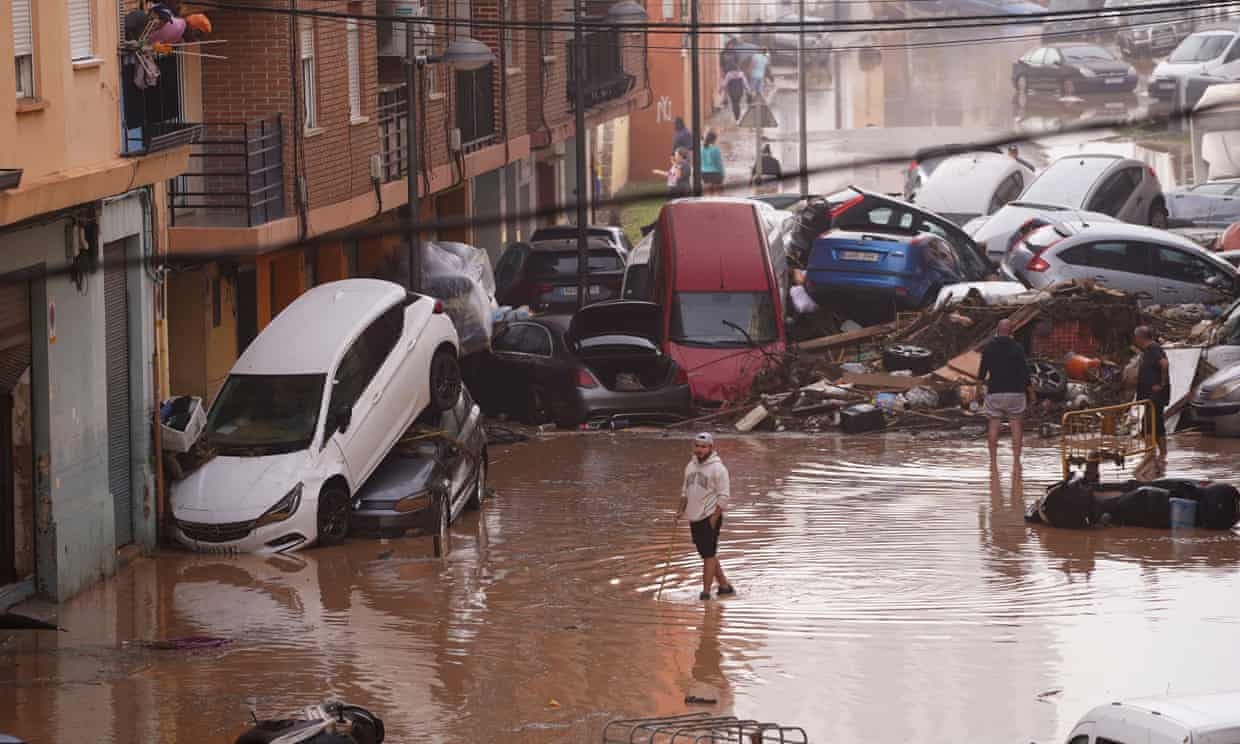
Inequality also intersects with climate change is less obvious ways that are hard to capture. As the climate squeeze intensifies, the price of everything will go up, while increasingly frequent disruptions will make it harder to find and keep a job, or to get to school or college, or even just to access essential services.
One of the headline changes to public opinion on climate change over the past five years has been to understate the immediate impacts - its something that will happen in the future, or somewhere else. As I’ve written before, people also often mistake the impacts of climate change as being symptoms of broader social decline. And its true climate change is already increasing inequality between the global North and South. But as the growth of flood risk ghettos and neglected coastal towns show, the convergence of austerity and climate change is intensifying the gap between rich and poor in the global North, and risks massifying ‘shit life syndrome’ into a general expression of the climate squeeze.
Coastal retreat
Continuing on the scientific theme, Grist last month put together an article explaining the import of two recent articles on sea level rise. Apparently baselines were too low, meaning:
Sea levels are much higher than we thought. Real-world oceans are making a mockery of flood-risk forecasts based on crude global modeling. And to make matters worse, coastal lands almost everywhere are subsiding faster than anyone realized — often many times faster than the seas are rising.
This means 80 million people, and not ‘just’ 40 million, are at immanent risk from sea level rise because they are already living below sea level.
For many low-lying coastal areas, scientific forecasts of how soon they may flood as sea levels rise may be off by several decades
“Several decades”
This will come as no surprise to people already impacted by sea level rise and coastal erosion, especially as in places like Hemsby people are losing their houses decades earlier than they had been told by surveyors.
The second paper covered looks at river deltas, and concludes subsidence impacts more than half of the world’s most populated deltas, with many of those having subsidence rates higher than rising tides, effectively doubling sea level rise rates. In some cases the combination is so bad sea level rise is occurring at ten times the global average rate.
Deltas have been crucial socio-economics sites for thousands of years. They currently house up to 7% of the global population, hosting 10 of the world's 34 megacities. River deltas are responsible for approximately 4% to 6% of global GDP - the Yangtze River Delta alone contributes roughly 25% of China’s national GDP. They are also crucial agricultural zones, producing 4% of the world’s food. This understates how critical they can be at a regional level, as well as in increasingly fragile global supply chains - the Mekong Delta accounts for nearly 12% of the world’s rice exports and 50% of Vietnam’s rice production.
All of this means millions of people, as well as vital agricultural and economic infrastructure, is at much higher risk of coastal flooding much sooner than expected.
Worse,
Researchers say many deltas and other low-lying coastal areas not included in the two studies are at greater risk than believed and urgently require detailed investigation of both actual sea levels and the rate of land subsidence.
Worse on purpose
I wanted to highlight this project - mapping enshitification of major products from backpacks to powertools. As with shoddy work on the transition and outright fraud, the steady worsening of everything is one of those political issues that enrages people but rarely finds itself subject to political interventions. Potholes might increasingly be the totem of local political fortunes in the UK, but its rare to find a political consumer champion. Especially as the Left rarely thinks of consumer politics as a fertile ground for organising (despite the success of campaigns such as Don’t Pay, or the long history of cooperative movements).
As with the previous two stories, this is more than a story about shrinkflation. Cutting corners both endangers people and impacts the poorest the most. For example, in investigating wholesale restaurant food distributor company Sysco, they find a systematic program of fraud and health violations. E.g.,
The first receipt is in California, 2014. The state's Department of Public Health investigators found that Sysco had stored 405,859 food items, including raw meat, in 25 unregistered sheds across the state for a total of 23,287 days. The sheds were unrefrigerated. Some held raw meat at 80°F next to insects and rat traps. Sysco's sales representatives loaded the food into their personal cars and drove it to schools, hospitals, and private restaurants. The state collected a $19.4 million settlement, and Sysco employees in subsequent reporting confirmed the same shed practice in Nevada, Washington, Utah, Tennessee, Illinois, New York, the District of Columbia, and Ontario.
You turn to such vendors when you need to save money - Sysco is a ‘center-of-plate as loss leader’ company, selling you cheap protein. This is not a US story where we can smugly look across the Atlantic as unfettered capitalism gone wild. The same thing has happened countless times in the UK as both the Tribune and Byline Times have reported.
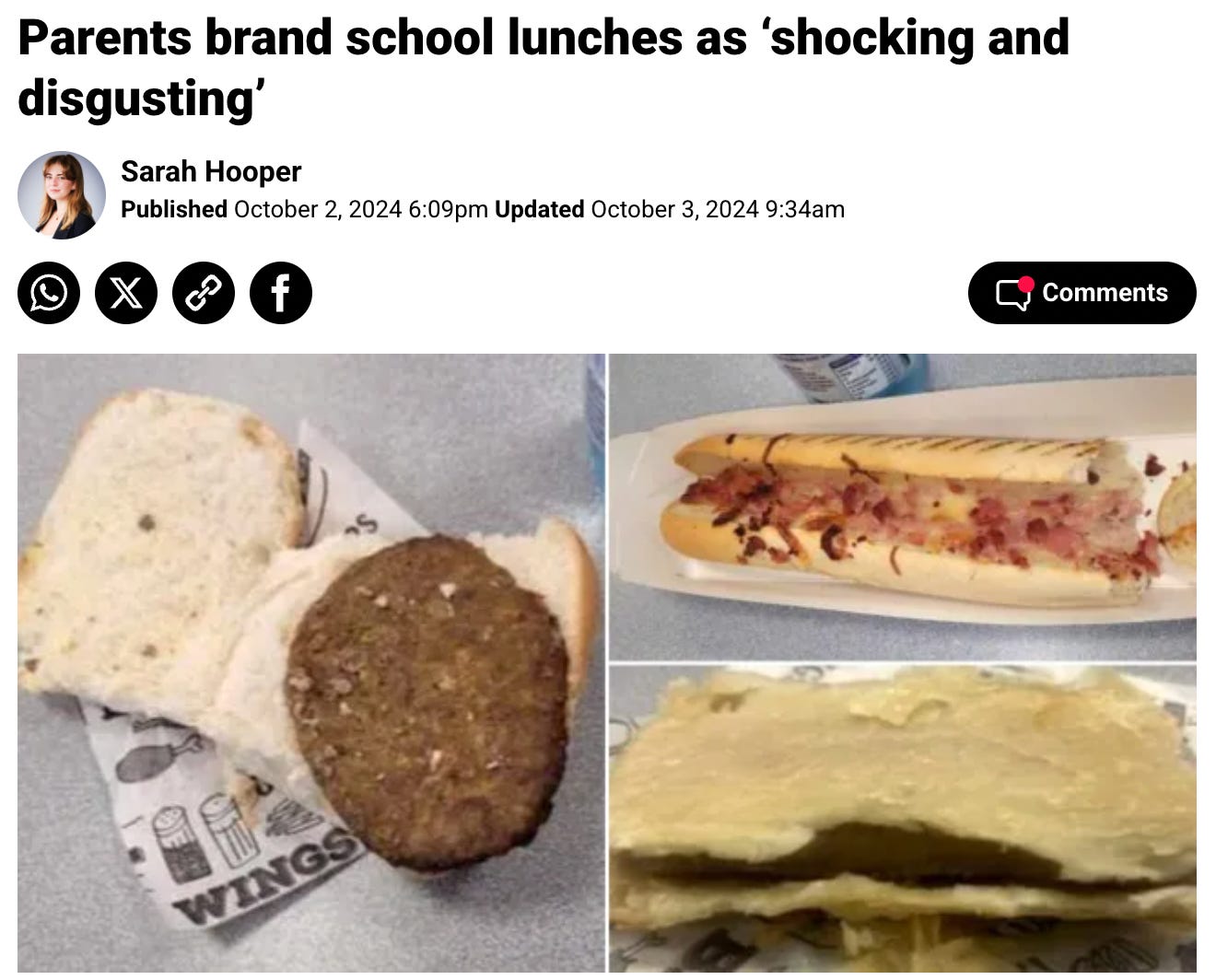
The miserable school meal ‘hampers’ are the latest public services outsourced to for-profit companies that consistently fail to deliver. Childhood hunger should not be lining private pockets.
- The Great School Meals Rip-Off
£1.5 Billion Profits, Hefty Government Contracts and Big Political Donations: The Firm Behind the Free School Meals Scandal
- Byline Times
Food as a general category is inelastic - you need to eat. To be sure, people are buying less, and now over half of the population have changed how they shop to buy cheaper brands and frequent discount stores. Councils are axing what food services they still run, forcing schools and other customers to source meals from dubious ‘lowest bidder’ providers.
All of this will get worse as climate change increases both food prices and operating costs. In many ways this year will offer a glimpse of the future as we may reach as high as 1.9C off the back of a super El Niño. Couple that with higher fuel and fertiliser prices - where you can still buy fertiliser - and continued local government cost cutting, and it may be a bumper year for catering companies as well as health scandals.